 cache.lat
 notes

PHP 8.5.12: security release and what to do in your WordPress
PHP released security version 8.5.12 on October 21. What to check in your WordPress, how to update without risk, and what happens with your cache.

Cache-Control in WordPress: Which Cache Headers Do You Need
Cache-Control headers decide how long the browser stores each file. We explain which ones to configure for pages, images, and CSS/JS in WordPress.

Cookies that break the WordPress cache and how to detect them
A single unnecessary cookie can prevent your visitors from ever receiving the cached page. We show you the most common ones and how to find them.
Autoload in wp_options: the hidden brake on your WordPress
Options with autoload are loaded on every request. Learn how to measure their weight, clean it up without breaking anything, and why it matters even with caching.

Load testing in WordPress: how to measure how much traffic it can handle
A practical guide to simulating many simultaneous visitors on your WordPress, reading the results, and seeing how much page caching changes things.

WebP and AVIF Images in WordPress: A Practical Guide
How to convert your images to WebP and AVIF, serve them with <picture>, and improve LCP without breaking anything in your WordPress.

WordPress releases security patches: what to do with your cache
On October 6, WordPress released security versions that fix XSS, DoS, and comment leaks. We tell you what to update and how to purge your cache afterward.

Is Your WordPress Slow Because of Hosting? How to Know
Before blaming the theme or plugins, learn to detect if your WordPress bottleneck is the server, with a simple diagnosis.
PHP 8.6 RC3: What to Test Today in WordPress Without Risking Production
PHP 8.6.0 RC3 and the RCs for 8.5 and 8.4 are ready for testing. What it means for your WordPress, how to test on staging, and what to do with the cache.

When and What to Purge in Your WordPress Cache (Without Losing Speed)
Purging too much hurts your performance; purging too little shows old content. A practical guide to knowing what to invalidate for each change.

TTFB in WordPress: what it is and how to actually lower it
TTFB is the time to first byte and depends mainly on your server. We explain how to measure it properly and how to reduce it with static caching.

How to verify that your WordPress cache is actually working
The plugin showing as active guarantees nothing. Five quick tests with curl and the browser to verify that your site is serving pages from cache.

PHP 8.2 and 8.4: End of Support by the End of 2026
PHP 8.2 security support ends on December 31, 2026, and PHP 8.4 closes its active support. A practical guide to migrating WordPress without breaking anything.

WordPress 7.2: How to Prepare Your Site and Your Cache
WordPress 7.2 has a proposed schedule: beta in October and final version in December. A practical plan to test and update without breaking your cache.

UTM campaigns and cache: don't let your ads bypass the cache
UTM parameters, fbclid, and gclid can cause your paid visitors to receive pages generated from scratch. How to detect it and avoid it.

Page cache vs object cache in WordPress: which one do you need
They are two different things that are often confused. We explain what each one solves, when it makes sense to combine them, and why static HTML is the most direct path for anonymous visitors.

WooCommerce Errors Under High Traffic and How to Avoid Them
The five most common mistakes that bring down a WooCommerce store when a traffic spike hits, plus a checklist to review before your next campaign.

WordPress 7.1.2 and PHP 8.5.11: what to update now
WordPress 7.1.2 fixes a critical vulnerability and PHP released security patches for 8.2 to 8.5. What to check today and how it affects your cache.

Plugins that slow down WordPress the most without the site owner noticing
There are plugins that consume resources on every load without you seeing it in the dashboard. We tell you which ones to watch and how to detect them before the site drags.
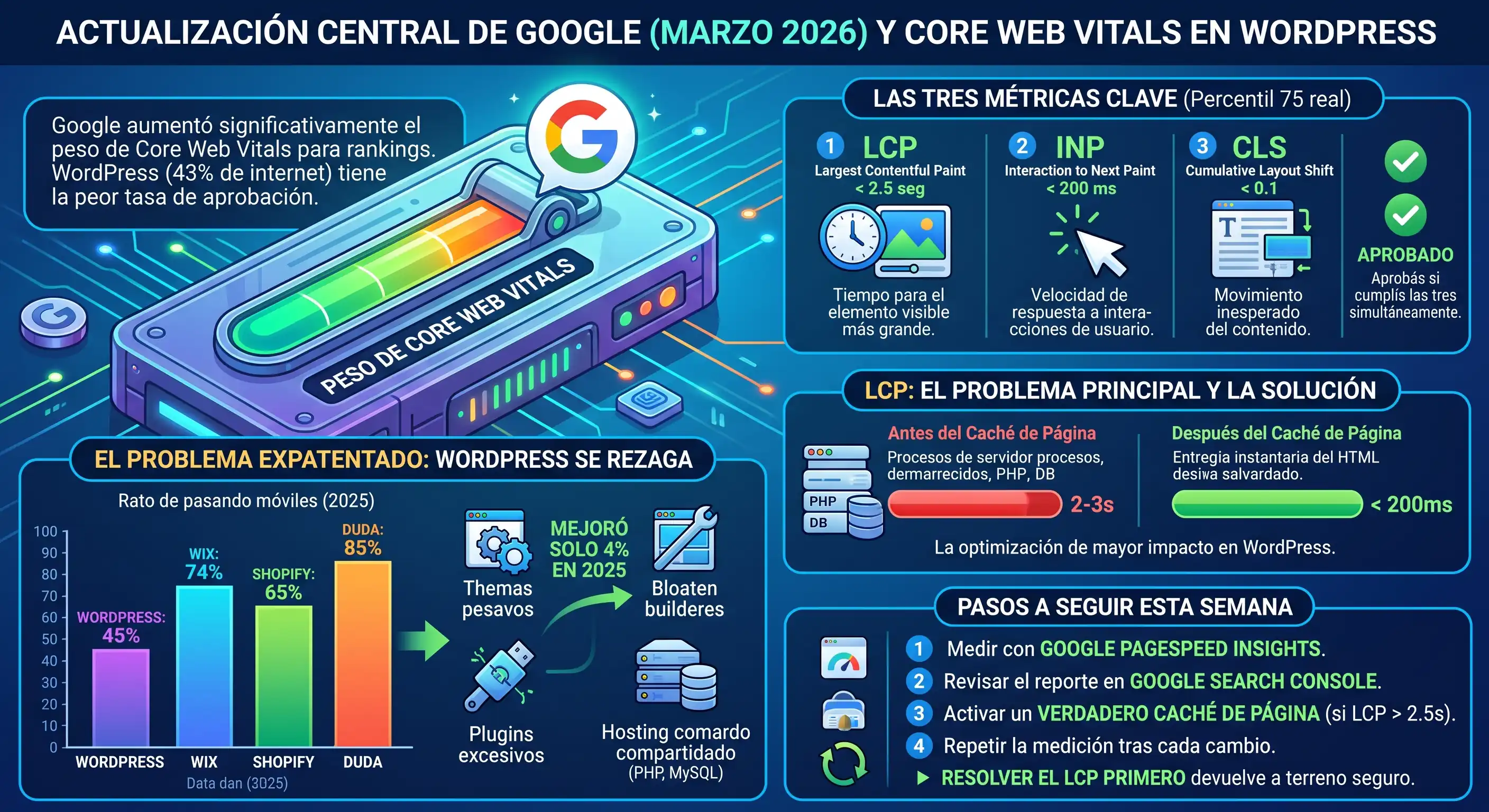
Core Web Vitals in WordPress: How to Pass in 2026
Of the three metrics, LCP is the one that most directly depends on how quickly your server responds before the browser even starts to draw anything. If your WordPress takes 2-3 seconds just to generate the HTML for each visit (running PHP, querying the database, building the page from scratch each time), you've already lost the margin before the first image loads.
How much faster would your WordPress be with cache.lat?
Measure your site for free and see an estimate of the improvement. No account needed.